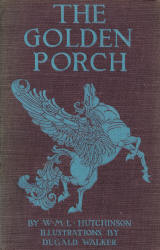
To the left is shown a rare copy of
The Golden Porch by
W M L Hutchinson - illustrated by Dugald Walker - as
published by Longmans, Green and Co. (New
York)
in 1925.
This copy shows the original decoratively blue-stamped
brown cloth cover.
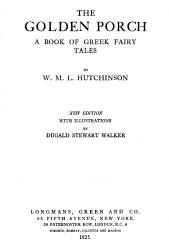
On the right is the Title Page.
The Golden Porch is
Hutchinson's adaptation of the work of the Greek poet of Antiquity, Pindar.
Hutchinson provides
an informative overview of the tale in his
Preface thus:
The name of this book is borrowed from the Ode in which
Pindar has enshrined the loveliest
of fairy stories - the "leaf-fringed legend" of the
Pansy Child. The poet was bidden to prepare
that Ode in honor of a friend's victory in the Olympic
Games, and he likens his task to the
building of a palace. Golden pillars, he says, must
bear up the porch of this Hose of Song, and
the glories of the victor shall form those pillars,
glittering afar in the sumptuous frontal of the
fabric. Now, chief among the victor's glories, was his
descent from the namesake of the Pansy,
the holy Seer of Olympia, and so, through that Golden
Porch, Pindar leads us into Fairyland.
In adding one more of the innumerable collection of
stories from the Greek, I have hoped to
break fresh ground by reproducing the myths of Pindar's
Odes, as far as possible in a free
translation, and with such addition only as were needed
to form a framework. Some of these
legends are already wholly or partly familiar, but
several will be new, I think, to English readers.
It may be said that Greek myths, especially as handled
by the poet who wove into them his
deepest criticisms of life, are misleadingly, if not
profanely, entitled fairy tales.
But I would plead the nothing in Greek literature,
except the stories of Herodotus, is so steeped
in the true fairy atmosphere as are the myths of Pindar.
I need not speak of Aeschylus, the
creatures of whose Titanic imagination belong to a
universe of their own; but consider, for
example, the poet of the Odyssey. His
wonder-world, though real, lies far away; Odysseus, he
makes us feel, has only to get back to Ithaca, and he
has no more chance of encountering a
Cyclops or a Laestrygon than you or I have. For Pindar,
on the contrary, all Hellas is enchanted
ground; it was in Arcadia, in Argos, in his own Thebes,
that men of old fought uncanny
monsters, entertained divinity unawares, and learnt
Earth's secrets from talking beasts and birds.
What wonder, if for him, living in such a land, and
turning from the upheaval of a new era
to gaze fondly on an ideal past, that vanished world
came alive again! At least, it is one charm
of his story-telling that he seems to be describing
things he saw happen with his own eyes, and
another, that the marvels befall quite simply, and, so
to speak, intelligibly, in the natural cause
of event.
To these essentials of the perfect fairy tale, Pindar
adds the accepted dramatis personae - the
brave young prince, the wicked king, his foil, and the
incomparably beautiful princess. And
always, as in fairy tales all the world over, the
wicked king comes to a bad end while the
deserving hero lives happily ever after.
The legends of the Trojan War belong of course to a
different category, for between the time
of Heracles and the time of Achilles the sun of the
fairy age has set.
It should perhaps be mentioned that some of the stories
here presented are put together from
the myths of several Odes, and most contain a good deal
not to be found in Pindar. But where
I have used other sources, or invented details, I have
tried firstly to introduce no version of
a myth no undoubtedly current in Pindar's day, and
secondly to remember his maxim, that
"disparagement of the gods is a hateful art".
Walker's treatment of Hutchinson's adaptation of
Pindar's Odes show a glorious appreciation of the form and lines
developed by artists in Antiquity - throughout
both his extensive monotone suite of illustrations and his wonderful
colour frontispiece that is
highlighted in lapis and turquoise.
Our Greeting Cards and Reproduction Prints
For connoisseurs of Walker's work, we have prepared sets of 20 Greeting Cards displaying
the major monotone images from his designs for The Golden Porch and on the
left, we show an example of how these Greeting
Cards appear.
Code: DW
GP MS(20) Price: US$100.00
When presented on Greeting Cards, these
images are prepared as tipped-on
plates - in hommage to the hand-crafted
approach typical
of prestige illustrated publications produced in the early decades
of the 20th Century. Each card is
hand-finished and the images are presented
on White
card stock with an
accompanying envelope. The rear of each
card carries information about Dugald
Walker, this wonderful suite and the profiled
illustration - we have left the
interior of the cards blank so that
you may write your own personal message.
Should you wish to order a Reproduction Print of one or
more of these images, we have provided some options below.
Each of these large format prints is also accompanied by
information about Dugald Walker, this suite and the profiled
illustration.
To purchase, simply click on the appropriate "Add to
Cart" button and you will be taken through to our Shopping Cart
secured through PayPal. Multiple purchases will be consolidated
by that feature and shipping and handling costs to any
destination in the world are accommodated by our flat-rate fee of
US$20 for every US$200 worth of purchases.
Of course, should you wish to discuss some customised
options, we welcome your contact on any matter through
%20(card)%20(sample).jpg)
.jpg)
.jpg)
.jpg)
.jpg)
.jpg)
.jpg)
.jpg)
.jpg)
.jpg)
.jpg)
.jpg)
.jpg)
.jpg)
.jpg)
.jpg)
.jpg)
.jpg)
.jpg)
.jpg)
.jpg)
.jpg)
.jpg)
.jpg)
